CONTACT
CLIENT PROJECT
Social commerce · Consumer experience · Product design
A new live-commerce experience designed for Taobao’s DianTao platform.

Project Overview
DianTao Live+ explores how livestream commerce could become a broader content and community experience. The concept connects content discovery, social interaction and shopping within a more continuous journey, giving users new reasons to engage with the platform beyond individual purchasing moments.
Role
Product Designer
Company / Client
Taobao · Alibaba Group
Team
Taobao stakeholders and a multidisciplinary design team
Responsibilities
User research, opportunity framing, experience strategy, concept development, interaction design and prototyping
01 Solution
I reframed DianTao as more than a place to enter a livestream and buy. Live+, short videos, product notes and social participation connect the moments before, during and after a stream, giving people reasons to return even when they are not ready to purchase.


02 Competitive Analysis
I compared DianTao with Douyin, Pinduoduo and Xiaohongshu across positioning, audience, selling point, feature priority and path to purchase. DianTao assumed a clear shopping intention from the start; the others first attracted people through short video, low-price discovery or social content. That showed where DianTao was thin: it offered few reasons to browse or interact before a user was ready to buy.

Click to see Positioning & Gaps
A side-by-side comparison of DianTao, Douyin, Pinduoduo and Xiaohongshu across audience, product focus and path to purchase.
03 User Research and Interview Analysis
The research included 17 participants: 12 people who had used DianTao and five who had not. Among the DianTao users, eight had bought through livestreams and four had watched without purchasing. In-depth interviews explored motivations, previous experiences and expectations; an online questionnaire then checked whether the same patterns appeared across a wider group.

User Research
04 As-Is User Journey and HMW
I mapped the journey before, during and after a livestream: previewing and subscribing, entering the room, browsing the shelf, asking questions, ordering and receiving the product. Four breakdowns stood out. People had too little information before entering; the shelf became hard to scan during a busy stream; promotions interrupted comparison; and the experience largely stopped after payment. Those moments became the basis for the design.
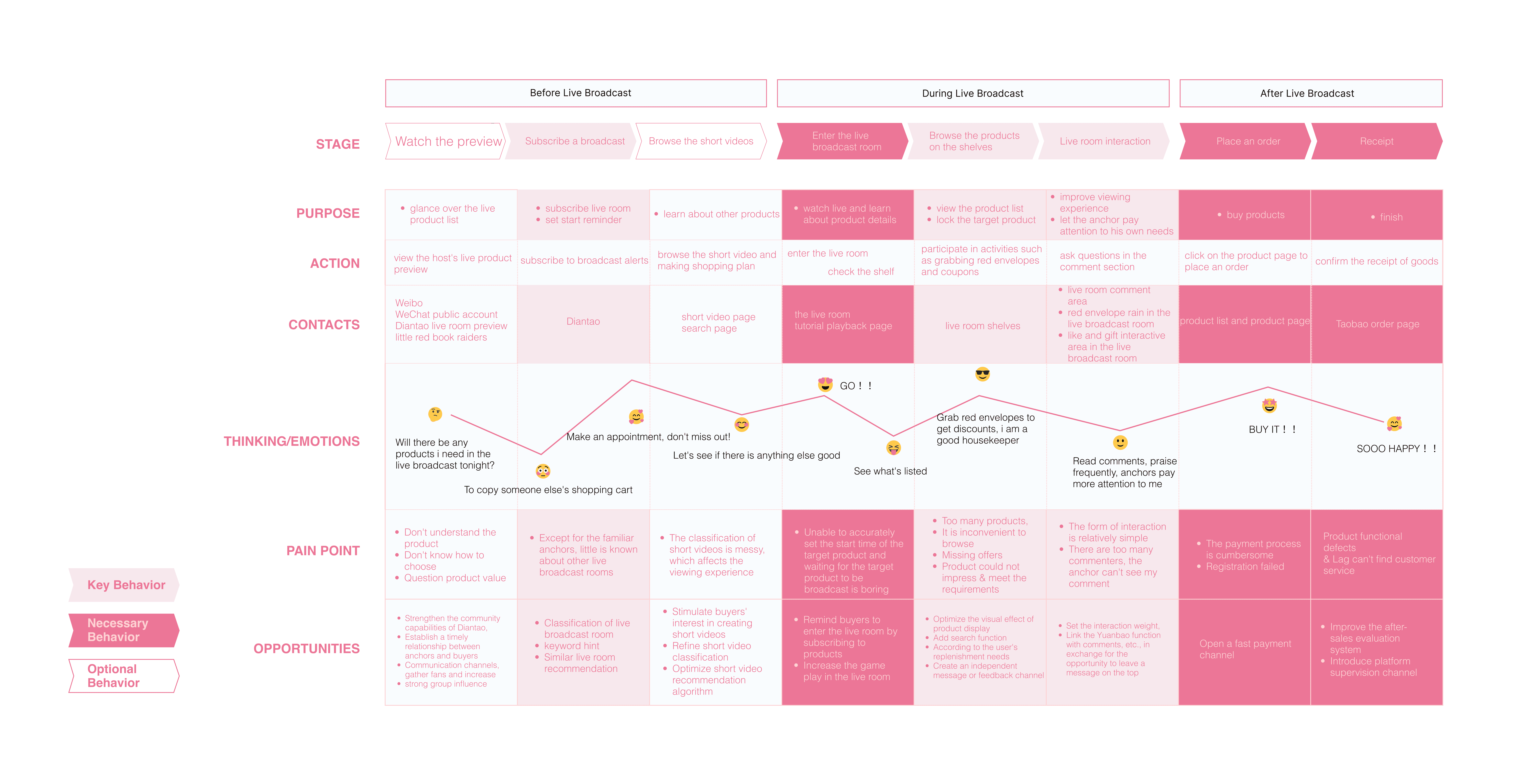
As-Is User Journey

Opportunity / HMW
05 Workflow and Information Architecture
The core path stays simple: enter a livestream, check the shelf and order. If a product is missing or unclear, the user can ask the host for an explanation and return to the purchase path after the demonstration. Inviting friends and saving product notes sit off that main route, so the social features add context without getting between the user and checkout.

Information Architecture
06 Wireframes

Early wireframes tested the core live-shopping flow before moving into visual design.