CONTACT
Final Installation and Exhibition
Speculative art installation · exhibition
A speculative installation that lets a large language model imagine and physically express its own body through voice, magnetic movement and ferrofluid.

Project Overview
AI Alien is a speculative installation exploring AI embodiment.
The project started with a question that sounds slightly absurd — and that was precisely the point: if AI had a body, what would it imagine itself to be?
Almost everything that constitutes AI today , its training data, language, interfaces, and even the concepts we use to describe it , is produced by humans. AI therefore has no inherent physical form, nor an independent reference for imagining what its own embodiment should look like.
Instead of designing another humanoid robot and deciding on AI's appearance ourselves, we invited AI into the design process and explored how it would describe its own form, materials, movement, and physical presence.
Role
Product Designer
Responsibilities
Research, arduino programming, prototyping and design
Exhibition
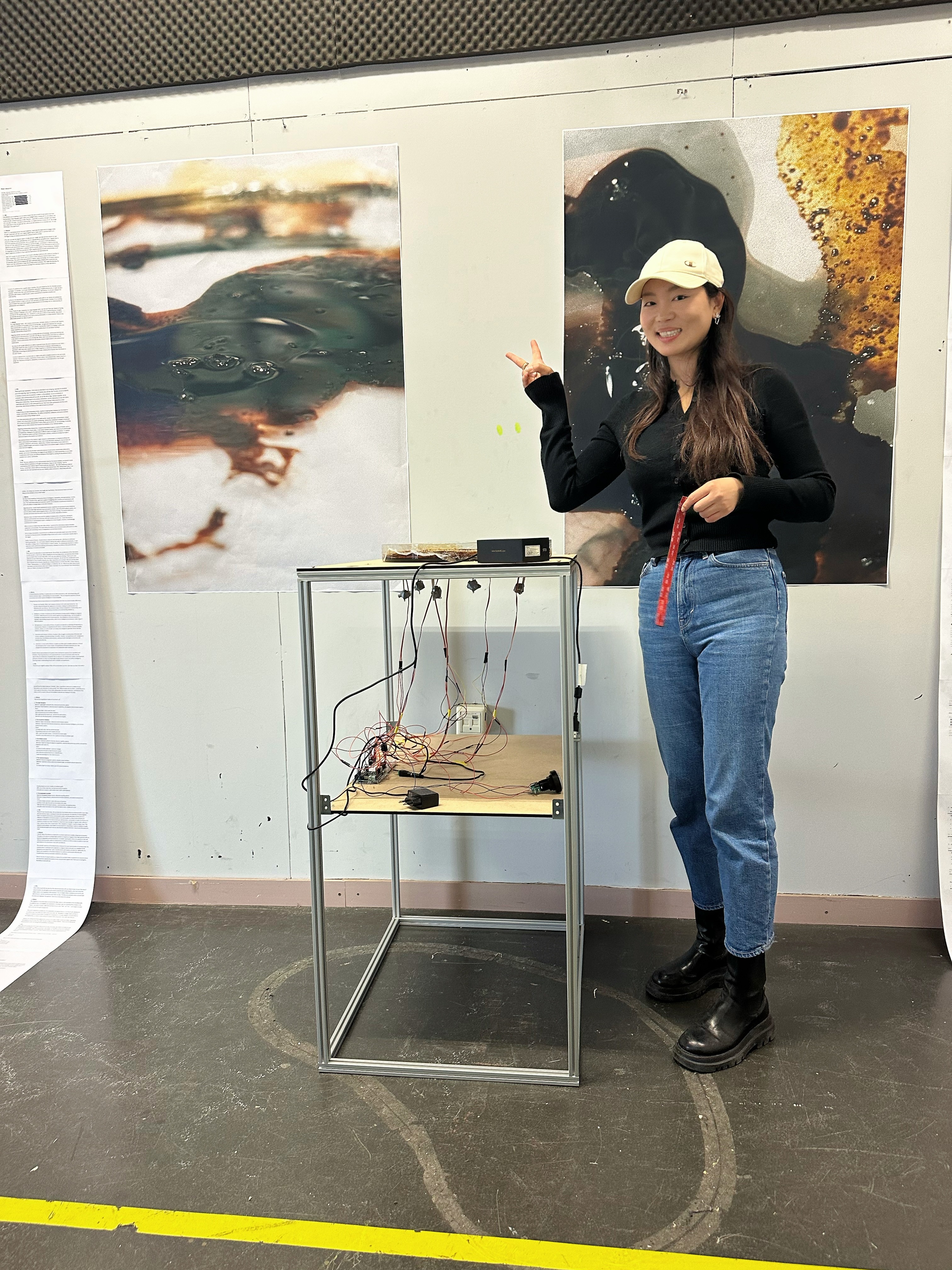
The final outcome was presented as a physical installation in a public exhibition.
Alongside the installation, we printed and displayed the original conversations with the different AI models in the exhibition space. Visitors could therefore see not only the resulting AI “body,” but also the conversations and interpretations through which that body gradually emerged.
AI Alien was never intended to provide a definitive answer to what AI should look like.
Instead, it was an experiment in changing the way we encounter artificial intelligence: what happens when AI is no longer confined to a chat window, but is given material, movement, space, and a body?
The final form was therefore not simply “the body chosen by AI.” It emerged from a negotiation between AI-generated language, human interpretation, material properties, and technological constraints.

From AI Conversations to Physical Form
Our process started with conversations rather than sketches.
We spoke with several leading AI systems at the time, including ChatGPT, Gemini, Claude, and DeepSeek, asking them questions about embodiment, materials, movement, form, and how an artificial intelligence might exist physically.
Rather than following the output of one model literally, we compared the conversations and looked for recurring descriptions across different AIs. By extracting overlapping keywords and qualities, a shared image gradually emerged: something fluid, dynamic, highly technological, and distinctly non-human, while still carrying a sense of life and presence.
These linguistic patterns became the starting point for our visual, material, and movement explorations.
We continued using conversations with different AI systems to explore possible materials. This led to a series of physical experiments, including explorations with ferrofluid, reflecting surfaces, mechanical movement, and other material qualities that could express the tension between digital intelligence and physical presence.


Experimenting with AI and Interaction
In parallel, we explored available large language models on Hugging Face, experimenting with how language models could become part of a physical interactive system.
The goal was not simply to place a chatbot inside an installation. Instead, we were interested in a broader translation problem: How can an AI identity expressed through language become movement, behaviour, and physical form?
As the project developed, our focus gradually shifted away from AI as something experienced through a screen and toward AI as something that could occupy and behave within a physical space.

The installation was developed through material experiments, mechanical layouts and full-scale prototypes. We positioned the magnetic arms, built the frame and electronics by hand, and adjusted the setup through exhibition trials at TU/e and NEMO.
Building the Embodied AI
The project was developed by a team of three: two Industrial Design students and one Human-Technology Interaction (HTI) student.
My main responsibility was the hardware development and physical prototyping, particularly the Arduino and robotic-arm system.
I developed and adjusted the control logic required to move the robotic arm accurately, working on its movement paths, positioning, and timing so that the installation could behave in the way we intended.
Movement was not simply a technical requirement. It strongly influenced how the embodied AI was perceived. Motion that was too regular immediately felt industrial and machine-like, while completely random movement lost any sense of intention. Through repeated prototyping, we adjusted precision, rhythm, mechanical behaviour, and visual effect until the movement, material, and physical structure worked together as one embodied presence.